
Winshark casino games and software providers
 Available in US
Winshark combines slot titles, live-dealer tables, classic casino games and newer formats such as crash games and game shows. The reviewed catalogue names many software studios and game categories. A useful comparison separates what kind of game is being played from which studio supplies it, and from the uncertainty of any individual outcome.
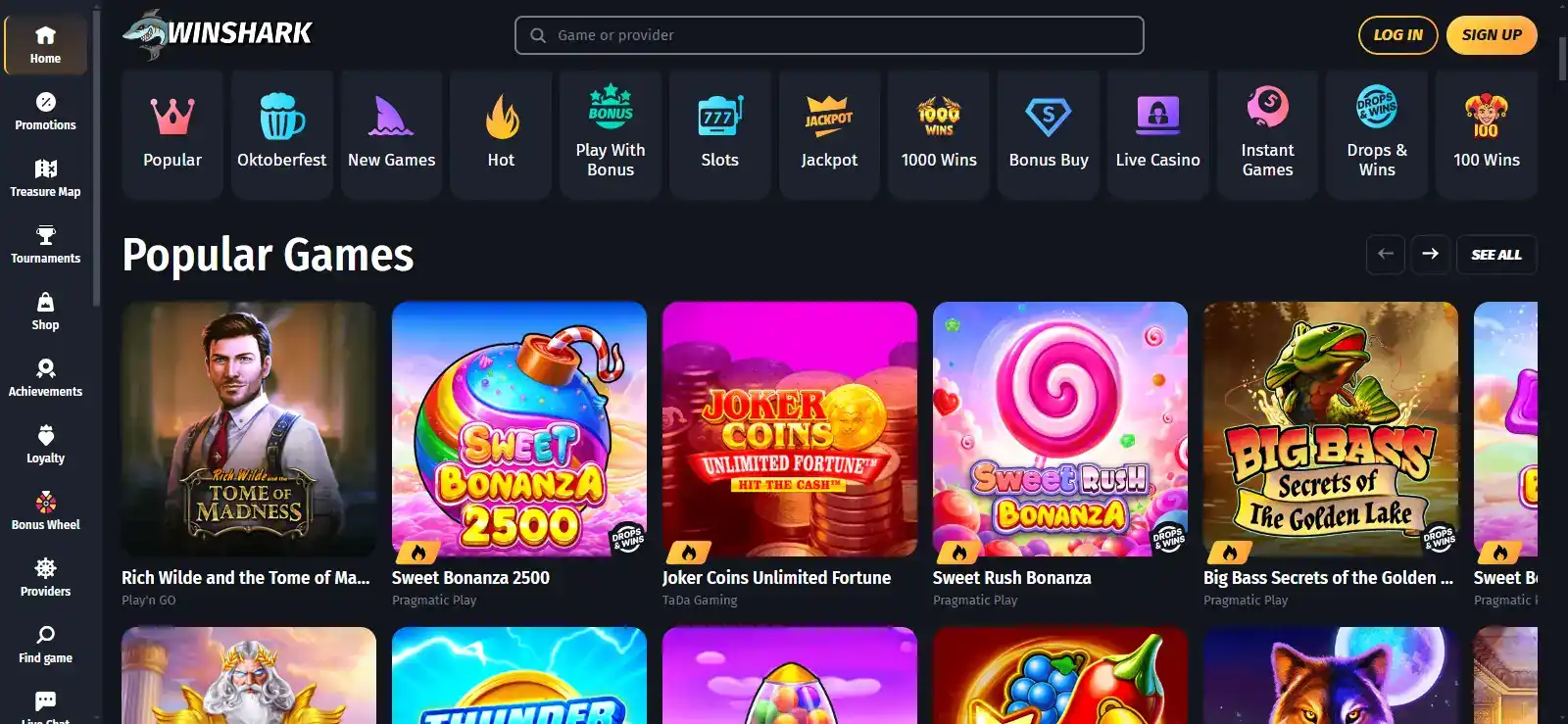
Game formats: slots, tables, bingo and crash games
Winshark’s reviewed game categories include slots, roulette, blackjack, baccarat, video poker, live dealer, bingo, jackpots, crash games and game shows. These are not interchangeable labels. A video slot uses paylines or other symbol-matching mechanisms; a roulette round resolves around a wheel outcome; blackjack combines card rules with player choices; and bingo follows a draw-and-match structure. Each format sets its own pace and can express its payout rules in a different way.
Slots can vary in reel structure, paylines, volatility and bonus rounds. Volatility refers to the pattern and spread of outcomes, rather than a promise that one game pays more reliably. A jackpot feature may offer a large possible prize but does not make that prize likely. Even a visually similar pair of slot titles can have substantially different pay tables. The pay table attached to the individual game is more meaningful than a general claim about the slot catalogue.
Roulette presents a fixed set of numbered outcomes and betting areas. Different roulette variants can use different wheels or rules; the distinction matters because it changes the theoretical proportion retained by the house. Blackjack allows choices such as hit, stand and other permitted actions, but the resulting outcome still depends on the dealt cards and the variant’s rules. Baccarat is primarily a comparison of two hands under predetermined drawing rules. Video poker adds a draw-and-hold decision to a defined poker-hand pay table.
Crash games use an increasing multiplier that can end unexpectedly. The visible multiplier is not the same thing as a guaranteed return: the central risk is the sudden end of a round before a chosen exit. Game shows bring a broadcast-style presentation to chance-based mechanics, whereas bingo usually follows a number or symbol draw. A category name helps a reader understand the format, but it does not establish the odds, return-to-player percentage or limits of an individual Winshark game.
| Category | Typical structure | What matters |
|---|---|---|
| Slots and jackpots | Symbol and feature outcomes | Game-specific pay table and volatility |
| Roulette and baccarat | Table-game outcomes | Variant rules and available bet types |
| Blackjack and video poker | Cards with permitted decisions | Rules and pay schedule |
| Live dealer | Streamed table action | Game format, pace and table conditions |
| Bingo and game shows | Draw-based or presented rounds | Underlying mechanics rather than presentation |
| Crash | Multiplier with an uncertain end | Exit timing and potential total loss of a stake |
A catalogue can list both games and categories, yet those numbers answer different questions. Here the meaningful breadth is in the named formats and studios. The category and provider breakdown is more useful for comparing formats than a single total of games, which changes as a catalogue is updated.
Software studios in the Winshark catalogue
The independent Casino Guru catalogue identifies 139 game providers associated with Winshark. This is a provider count, not a count of playable titles, active tables or available games for a particular account. The named studios include Evolution Gaming, Pragmatic Play, NetEnt, Nolimit City, Play’n GO, Playtech, Red Tiger Gaming, BGaming, Spribe and Hacksaw Gaming.
Studios contribute different combinations of game formats, distribution systems and interface conventions. Evolution is widely associated with live-dealer content, while names such as NetEnt, Play’n GO, Nolimit City, Red Tiger and Hacksaw are associated with slot design. Pragmatic Play and Playtech operate across more than one broad casino category; BGaming and Spribe also have distinctive game portfolios. These associations describe the suppliers generally, not a promise that a specific title or provider format is accessible within Winshark from every account.
The provider name can be useful for distinguishing two games that share a theme. Studios develop different volatility profiles, feature sequences, table interfaces and visual treatments. However, a publisher’s presence in a catalogue does not tell a reader the precise rules of a given game. The correct reference remains the individual game’s rules and information panel.
- Game rules: look for a clear pay schedule, winning conditions and feature explanations.
- Betting range: separate a table’s permitted stakes from an account-level withdrawal condition.
- Session pace: fast repeated rounds can accumulate exposure even when individual stakes appear modest.
- Provider identity: distinguish a named supplier from the operator that hosts the catalogue.
A large supplier list can indicate multiple design styles without telling us how much time or money a session might involve. Two games from different studios can have comparable presentations yet different mathematical structures. The number 139 therefore works as a broad catalogue descriptor, not a safety indicator, quality score or substitute for specific game rules.
For readers comparing slot and table offerings, supplier breadth may matter less than the actual selection of formats. A person looking at classic table games may compare roulette, blackjack and baccarat variants, while someone studying slots may focus on volatility, symbols and the way bonus rounds are triggered. Provider lists and category lists are related but separate axes of a catalogue.
Live-dealer tables and game-show sessions
Winshark’s reviewed catalogue includes a live-dealer category. Live games typically show a human dealer or host through video while the participant selects among the permitted wagers or decisions through an interface. The presence of video changes the presentation and rhythm of a round; it does not remove the possibility of a complete loss of the stake. It also does not mean that all live games have the same rules or betting options.
Live roulette, live blackjack and live baccarat mirror recognizable table-game families, but each title may use different table conditions. A televised game-show format can include wheels, draws or bonus mechanisms with separate payout conditions. The show format is a presentation layer; readers need the rules behind it to understand the actual risk.
- Before a round: identify the game variant, table conditions and wager types.
- During a round: distinguish a game decision, if any, from an outcome decided purely by chance.
- After a round: assess cumulative expenditure, not only the last win or loss.
Game speed is consequential. A table that allows repeated decisions over a long session can expose more money than the opening stake suggests. Theoretical return-to-player (RTP) describes a long-run model under a game’s rules; it is not a promise that a player receives that proportion back during a particular session. Likewise, the house edge is a mathematical property of a specific wager, not a fixed rate for an entire casino.
Each game and variant has its own return-to-player model and rules rather than sharing one casino-wide RTP. Assigning one to the brand would blur important differences among table variants, slots and crash formats. Even when a published pay table gives a theoretical value, short sessions may depart sharply from the long-run model because outcomes vary.
Casino play should be treated as paid entertainment with financial risk, not a way to generate income. A set expenditure boundary can help make the cost of repeated rounds more visible, but it cannot make any outcome predictable. For payment limits and practical cashout context, the separate payment-method overview distinguishes transaction conditions from game mathematics.
A broad catalogue with distinct game mechanics
Winshark combines several game families with an independently listed roster of 139 providers. The breadth is clearest in the contrast between slots, conventional tables, live formats, crash games and game shows. Each game’s own rules and payout structure are more informative than catalogue size: neither a supplier count nor a polished live presentation reduces the possibility of financial loss.
Common questions
What games are listed at Winshark?
Slots, roulette, blackjack, baccarat, video poker, live dealer, bingo, jackpots, crash games and game shows.
How many providers are associated with Winshark?
Casino Guru catalogues 139 providers. That figure counts providers, not individual games.
Does a live dealer change the chance of losing?
No. A live presentation does not eliminate loss risk; the game variant and wager rules determine its mechanics.
Is one RTP figure available for the entire casino?
No single casino-wide figure is appropriate; each game and variant has its own rules and theoretical properties.
Read next
- Payment methods and cashout context
- Deposit methods in Canadian dollars
- Winshark casino overview
- Canada access and licensing
Written by the editors at Win-sharkca1.org.